The future of the touch screen is an oxymoron
The interaction systems with our devices do not stop evolving. When we had become accustomed to everything we could do through a touch screen, news such as voice assistants or gesture-based interaction erupted on the scene . Neither of them has come to be simply a technological showcase, both will be introduced in your phone to evolve and become a basic way to interact with your mobile device.
When we talk about gestures, we talk about performing them on the air, without even having to touch the phone, with the amount of advantages that it reports. The LG G8s has reached the market with this technology implemented and willing to demonstrate that a paradigm shift in usability is possible. Because, in fact, throughout history few devices have changed both their way of interacting with us and the smartphone.
Interacting with the phone: a little history
The mobile phone has had many evolutions in its interface throughout its life, we have become accustomed to interacting with it in many different ways, but always evolving towards more efficient and capable controls .
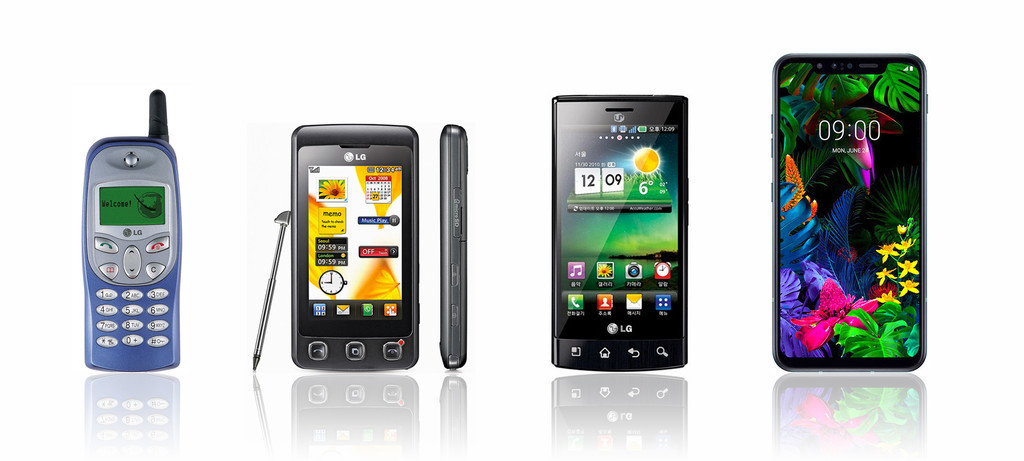
The first logical step has to do with the transfer of buttons and simple screens from the home phone to the laptop. Physical and alphanumeric keyboards that each company designed as best considered.
At the beginning of the nineties, very special products began to arrive, introducing the touch screen – IBM Simon -, yes, with technologies that only allowed us to point in areas of the screen. They were the first resistive panels, with pointers to make them work.
The next important step originated in the late 1990s, when capacitive screens entered the scene. They let users interact with their fingers and gestures could be made. Over the next decade, phones evolved this type of technology to achieve multi-touch interfaces.
The new gestures are made in the air
Mobile phones are assuming ways to be controlled closer and closer to a human’s natural interaction : recognition of voices, facial expressions or gestures that can be picked up by a camera. It seems logical that developers are trying to mimic our behaviors among humans also in interfaces.

Gestures allow the user to perform multiple actions at once , with a natural way of communication or interaction. For example, choosing an element to the right with a movement towards that side is something that comes naturally to us; We can say the same thing about the movement we make with our fingers when turning a dial. Imagine a phone that recognizes these movements in detail.
The complexity that can be achieved with this type of gestures is not comparable to what we can draw on the screen plane. If a system is able to recognize each finger of one hand, its independent movements, and the postures of the hand itself , the possibilities become virtually endless.
Let’s not forget that with its integration we are not losing any kind of interaction that we already had or that we can get with any other phone. What we are getting is a new control method that in many scenarios will be useful, it will give us security, even comfort.
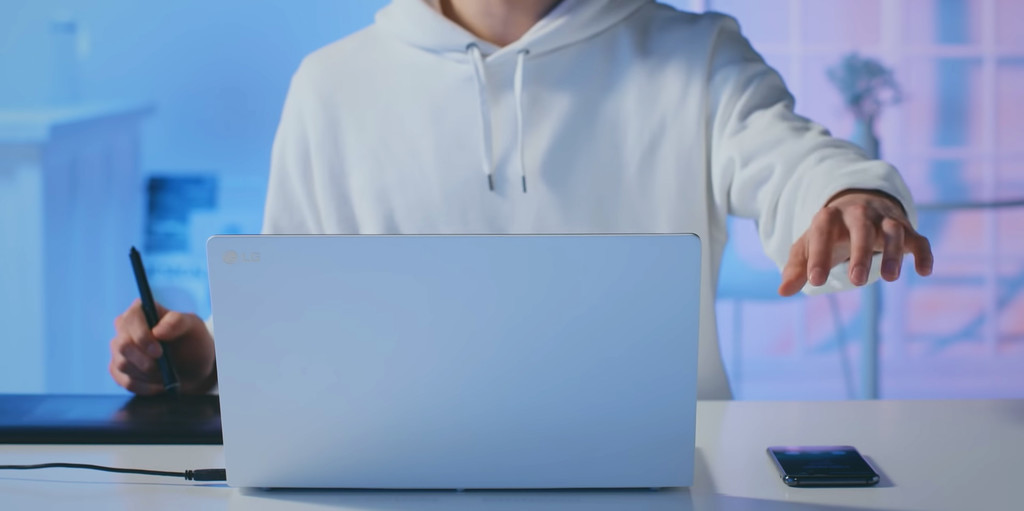
Obviously we are starting with technology and we must be accurate with really practical and intuitive utilities for the user. This is why companies like LG have created a series of very clear functionalities that allow us to enjoy technology, such as those presented by the LG G8s :
Your hand is your password: Hand ID
Can you imagine unlocking your phone with the palm of your hand ? The LG G8s introduces a new biometric security system that uses your veins as a unique identification system. Baptized as Hand ID is unique in this phone, with it you will not even have to touch the screen.
Both the operation and the configuration are quite simple, it is about placing our palm a little more than 15 centimeters above the front camera of the phone and from there the recognition will be made in the blink of an eye. These kinds of things much better check them in operation:
The interesting thing is that Hand ID is a complementary method , next to it are still present fingerprint recognition and facial unlocking. In the latter case, the system is especially safe when using the 3D sensors that the phone has on its front.
Z camera: the technology that puts magic
Known as the Z Camera , it is the first time that we find a system of these characteristics in the front area of the smartphone. With it you can record the depth at which the elements are, creating a 3D map that allows us to be much more effective with any type of recognition.
The secret behind the LG G8s is clearly one of the Z Camera sensors, called ToF (Time of Flight). Think of the sonar of a submarine: signals are sent through the middle and are waiting back to know what lies ahead.

In a ToF system something similar happens: an infrared beam of light is thrown on the object to be photographed, when this light hits its surface, a part of it is reflected in the opposite direction and returns to the ToF sensor. The time elapsed since the light was emitted is calculated to accurately measure the distance at which it is located.
As it seems logical, this operation has to be done many times and the information to be handled is very important in size, so the LG G8s uses a support processor called Infineon REAL3 . But there is more: with this technology we will control the phone without touching it, as we will check next.
Control your phone without touching it: AIR Motion
In addition to the improvements in security, we will gain in comfort in a series of points of the LG G8s interface , within what we know as AIR Motion , without ever having to touch its screen:
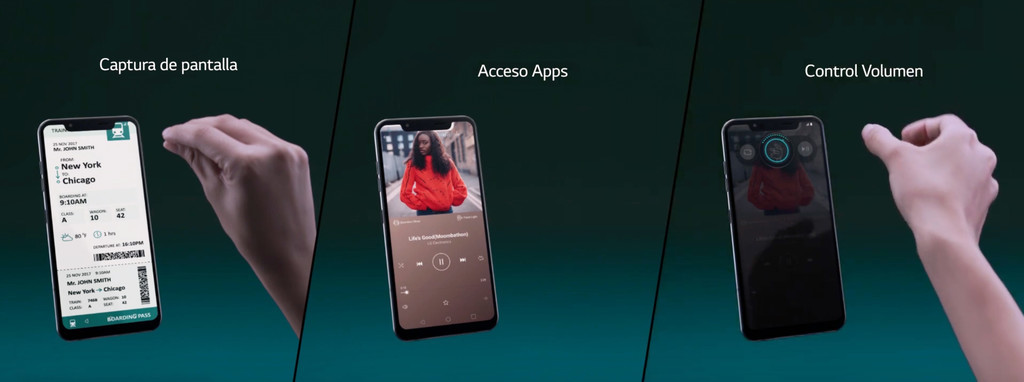
- Launch applications : select the two applications you use most and place them as a shortcut with a right or left gesture.
- Answer a call : they are calling you and skip an interface where we can answer or hang up depending on whether our gesture is left or right. The same can be done with alarms or a timer.
- Control the music : again we will use left or right to pause or play music. With a turn of our fingers we will raise and lower the volume.
- Capture screens . The most comfortable way to do it, with a pinch in the air we will capture what we have on screen at that time. Again, these things better check them in operation:
We have to be aware that when making the gestures there is a protocol to follow that, once we learn it, will be sewing and singing. We need to position the hand about 15 centimeters above the phone, at least three of our fingers will be recognized and the hand should be placed in a relaxed and flexed position , as if we were catching a computer mouse in the air.
And revolutionize the selfie
We can make portraits of a higher level thanks to the use of the aforementioned ToF sensor, which recognizes the distance to the subject and perfectly determines its location in space . From here all the effects that we want to apply will be performed with greater quality: background blur, custom backgrounds or special lighting effects.
As if it were a portable study , we can add light from any angle and the system will take into account the curvature of the face to generate natural shadows. Incidentally, the sensor is 8 megapixels with an angle of 80 degrees.
Taking advantage of the recognition of gestures, it is also possible to activate the selfie with a simple movement of our hand, as we can see in the following video:
Five cameras for any situation
We have already talked about the front cameras, now it is the turn of the three rear that complete the ” pentacamara “. With them we can shoot in super wide angle, telephoto or standard angle. In fact, we can both preview and shoot a shot with all three at once.
Thanks to the artificial intelligence of the AI CAM 3.0 function , the phone is able to identify what is on the scene and adjust the parameters accordingly, all automatically, without having to be connected to the network of networks.
The video is a very special section in the LG G8s , thanks to the ability to record video in 4K format at 60 images per second and to be able to introduce bokeh or blur in the shots, to highlight the main subjects.

In the search for the next smartphone that will make banking jump in the market, a company like LG cannot ignore the rest of the columns that support a high-end phone: a design as elegant as it is resistant , thanks to its IP68 certification (also military MIL-STD 810G), with glass finish and metallic sides.
The brain responsible for launching all its functionalities is none other than Qualcomm’s Snapdragon 855 , an ideal partner of a 6.21-inch screen with OLED technology .
The LG G8s finishes the play with its surround sound system with DTX X: 3D certification , optimized by Meridian specialists. To this we must add the presence of a real double speaker that provides an immersive experience.
via: tecnologialg.xataka


Comments
Post a Comment